EPISODE 001 · THE FOUNDATION
Everything Is a Model — Input, Processing, Output
Discover the Input → Processing → Output pattern that operates within us and throughout the world around us.
Watch on YouTube ↗Mastering Life, Leadership, and Decisions with Models
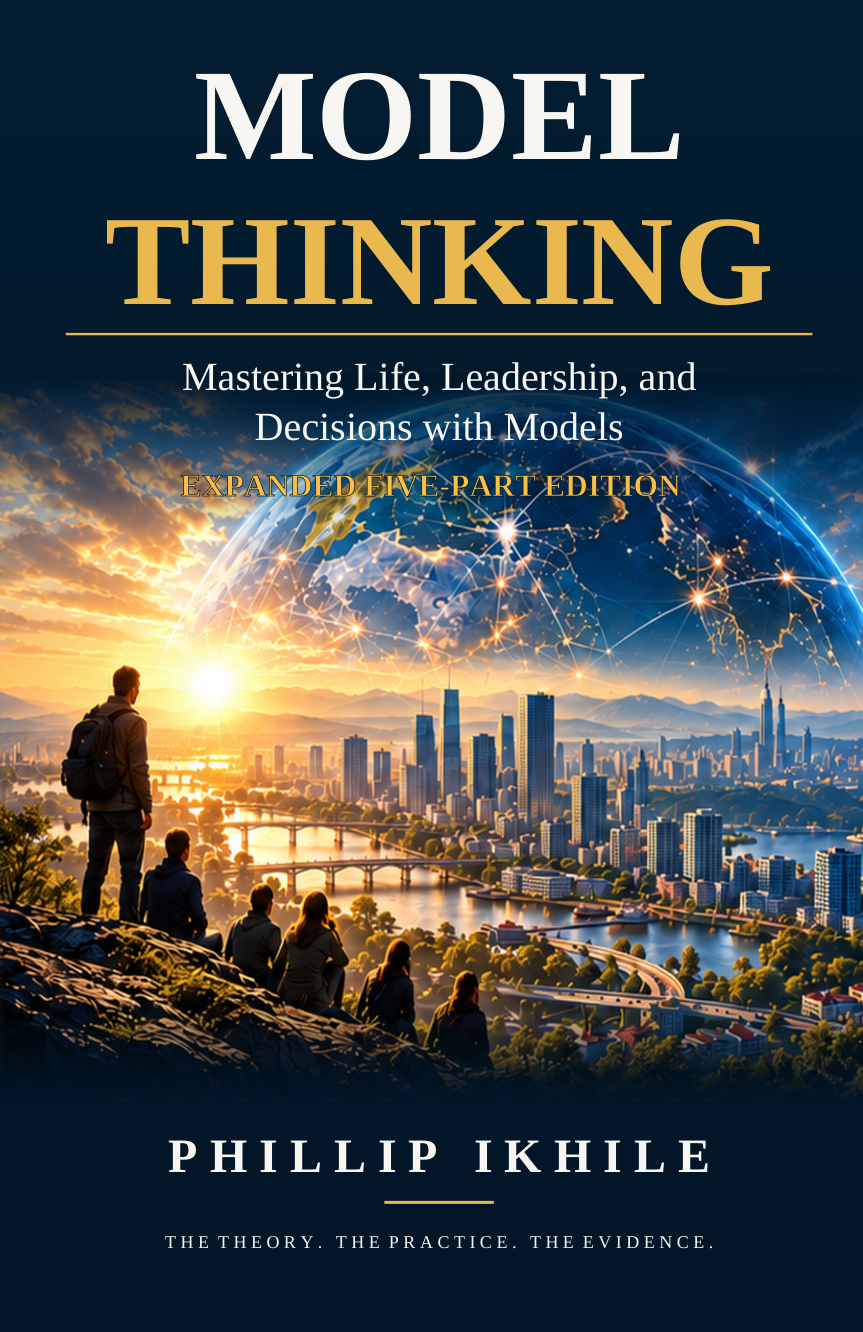
What if you could understand not just what happens, but why it happens? Discover a practical framework for thinking more clearly, deciding more wisely and building a better tomorrow.
By Phillip Ikhile
Read before you buy
Explore the introduction and sample all 62 chapters across the five parts of Model Thinking — one carefully selected opening passage from each chapter.
Download the free 72-page preview ↓PDF · Free · No registration requiredAudiobook coming soon · Two unabridged volumes Listen to the introduction ↓
Wealth Model Thinking · A private advance-reading invitation
We've explored the models that shape our decisions, organisations and societies. Now comes the question we simply couldn't leave alone: can we use that thinking to create wealth through useful economic activity?
A real undertaking. The thinking before we begin, the choices made along the way, and the evidence after 100 months. No ending written in advance. The Introduction and Chapter 1 of Thinking It are ready for private reading.
Reading access is individually approved. This is not an invitation to invest.

Model Thinking in action · 2027
One winning essay. ₦1,000,000. An invitation to people aged 18 or above worldwide to examine a provocative question: “A Hustlers’ Paradise Masquerading as a Nation”: A Fair Assessment of Nigeria?
The Prize takes the ideas in Model Thinking into public debate. Organised by ModelThinking.org, in collaboration with its media partners., it invites rigorous, original thinking about Nigeria and the models shaping its future. Explore the competition page for the theme, eligibility, rules and essay submission.
Explore the Prize and entry requirementsModel Thinking · Audio edition
The complete, word-for-word, unabridged Model Thinking is being prepared as a two-volume audiobook, narrated by Rowan.
While production continues, enjoy the Introduction to the Expanded Edition — a first listen to the thinking behind the five-part book.
Featured audio · Listen now
An invitation to explore the models shaping our decisions, organisations and societies.
3 min 31 sec · Rowan · Free preview
Download the introduction (MP3) ↓A different way to see the world
Every day we make decisions, solve problems, pursue ambitions and respond to circumstances we do not entirely control.
Why do capable people repeatedly make poor decisions? Why do successful organisations become inefficient? Why do sensible plans sometimes produce disappointing results? And why do some approaches work for years, then suddenly fail?
We tend to focus on the immediate event. Yet the real explanation may lie in the structure that produced it. Model Thinking begins with a simple proposition: almost everything around us can be understood through models. Once we recognise those models, we can examine how they work, why they produce particular results and how they might be improved.
The central framework
Whether we're examining a personal decision, a company, a school or a society, the same fundamental questions help us look beneath the surface.
What enters the model? Information, materials, money, skills, time, assumptions and instructions all shape what is possible.
What happens inside? Reasoning, judgement, people, procedures and technology transform inputs into results.
What does the model actually produce? Decisions, actions, products, services and measurable outcomes.
Feedback closes the loop. When results differ from expectations, feedback helps us understand why and decide what should change. Without it, weaknesses may persist unnoticed; with it, models can be evaluated, refined and adapted.
A familiar example
Imagine two people planning the same journey. Both have similar information about distance, traffic and weather. One compares routes, likely delays and arrival requirements. The other simply takes the route used last week.
Both may reach their destination. But if conditions have changed, one approach may be much more effective than the other. The difference need not be intelligence or effort: it may be the quality of the model being used.
Extend that reasoning to a career choice, a business expansion, an investment decision or a major personal change. The stakes become larger, but the underlying principle remains remarkably similar.
Inside the expanded edition
Model Thinking moves from personal choices to the larger structures within which people, organisations and societies operate.
Understand how your inputs, processing and outputs shape decisions, habits and everyday life.
Explore how teams, organisations and communities combine resources and processes to achieve collective results.
Examine how institutions and societal structures influence performance, alignment, drift and renewal.
Distinguish between tangible and intangible things, from products and tools to processes and systems.
Turn understanding into change by modelling decisions, interventions and intended outcomes.
Evaluate models against their objectives and identify where adjustment may be needed.
What the reader gains
Model Thinking is designed to develop a practical habit of examining the structures behind experience. You don't need to be a mathematician, programmer or management consultant to begin.
Look beyond immediate symptoms towards underlying causes.
Examine information, assumptions, alternatives and consequences.
Identify why a process repeatedly produces disappointing results.
Judge models in relation to their intended purpose.
See how smaller models interact within larger ones.
Organise the steps needed to move from the present towards a desired outcome.
Start exploring
The intention is not to provide a ready-made answer to every problem, but to offer a way of thinking that helps you ask better questions and understand your choices.
Watch the ideas come to life
Sometimes an idea becomes easier to understand when we can see it operating. Model Thinking Illustrated brings the philosophy to life through visual storytelling. Watch the opening episode, then see what happens when a company's success outgrows the model supporting it.
Discover the Input → Processing → Output pattern that operates within us and throughout the world around us.
Watch on YouTube ↗Explore what happens when growth puts pressure on the systems, people and processes that once made an organisation successful.
Watch on YouTube ↗About the author
Phillip Ikhile's professional experience spans accountancy, finance, investment, business management, software development, consulting and entrepreneurship.
Working across these fields has provided opportunities to observe how people and organisations make decisions, allocate resources, manage complexity and respond to change. Model Thinking brings these interests together around a central idea: understanding the structure of a problem can be as important as finding its immediate solution.
Choose your edition
The world will continue to present uncertainty, incomplete information and unexpected consequences. We can nevertheless become more deliberate about the models we use to navigate it.
For reading, study and everyday reference.
Buy paperback on Amazon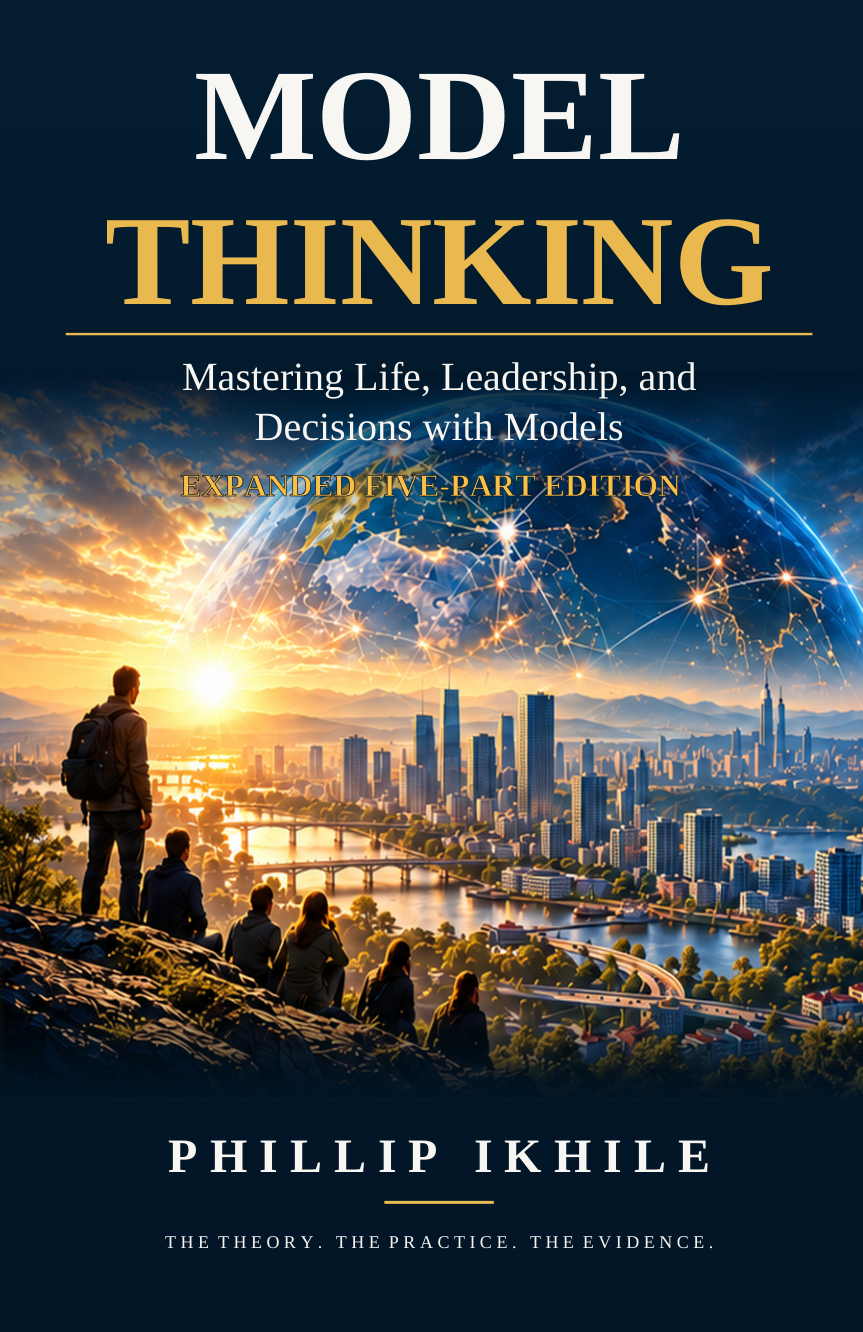
A durable edition for a personal or professional library.
Buy hardcover on Amazon